
Tracking southern resident killer whales among different combinations of boats and ships
September 6, 2017 · By Laura Bogaard & Scott Veirs
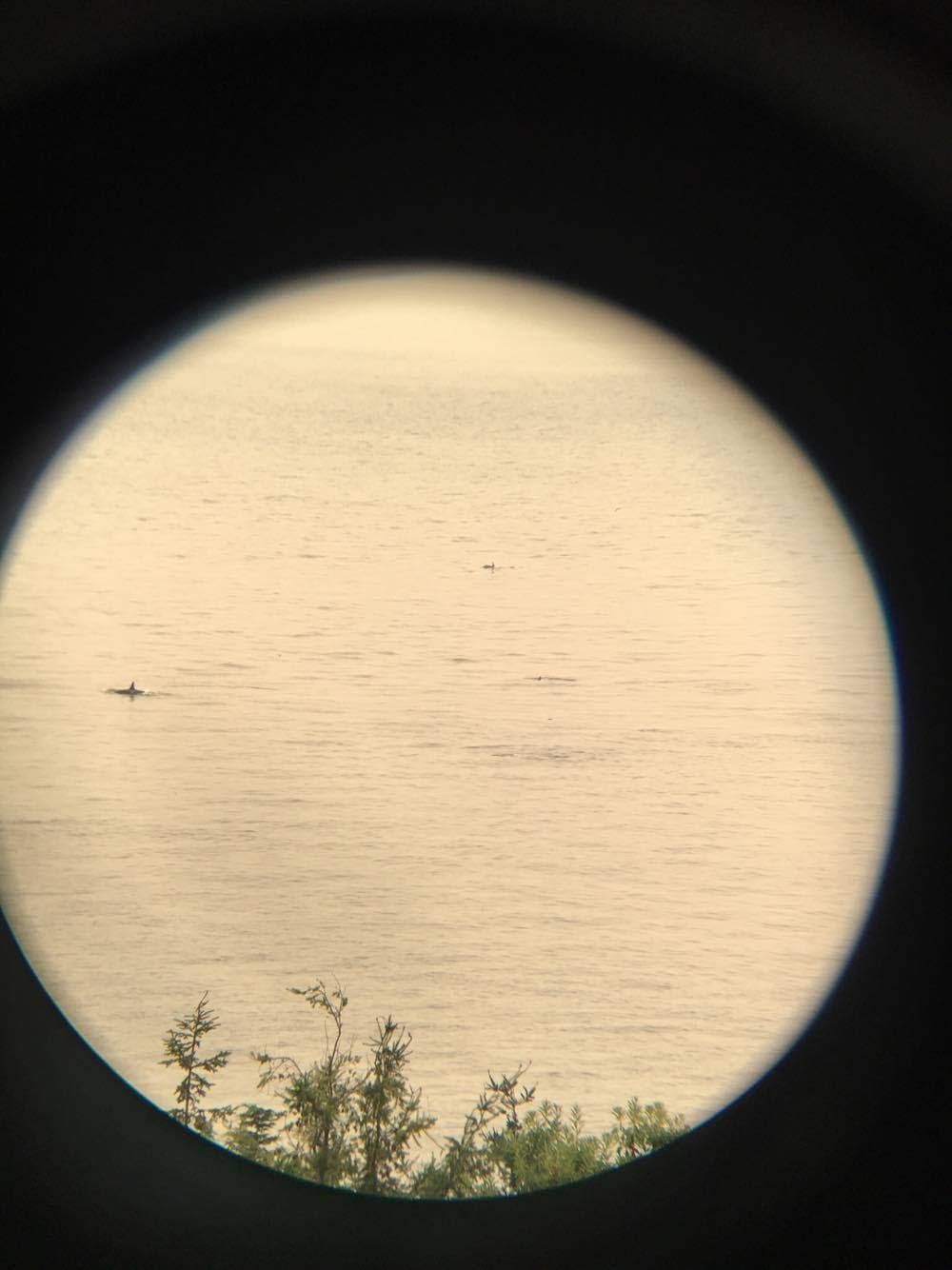
The view through my binoculars as the residents from J, K, and L pod passed by our southern theodolite tracking station this afternoon.
Wednesday, September 6, 2017
After quite a few reports of killer whales in our vicinity this morning, we decided to start our day searching for whales at our southern tracking station on the west side of San Juan Island. After scanning for a few minutes, we noticed a couple of whale watching boats were headed our way. It makes sense that when you are searching for whales, you will often see these boats before seeing any sign of an animal such as a fin or blow.
For the next hour, we tracked the southern residents as they swam by our station. Every five minutes we would perform a behavioural scan sample in which we recorded the dominant activity of the focal group. These whales were in an obvious foraging state: loosely dispersed individuals or small groups, slowly traveling south, maybe a few hundred feet off shore. As we waited for our focal male to surface so we could fix his location using the theodolite, we also noted the location and number of whale watching boats that were following along at a safe distance of at least 200m from the whales. Throughout this entire tracking session, not a single cargo ship went by which must have made for a relatively quiet evening for the feeding whales. The geography of the bluff we were observing from made it so we could hear every breath the orcas blew as they surfaced. We could also hear a delayed smack every so often as we watched a few slap their tails or pectoral fins and even breach a few times as they milled through the water in search of chinook salmon, their preferred prey.
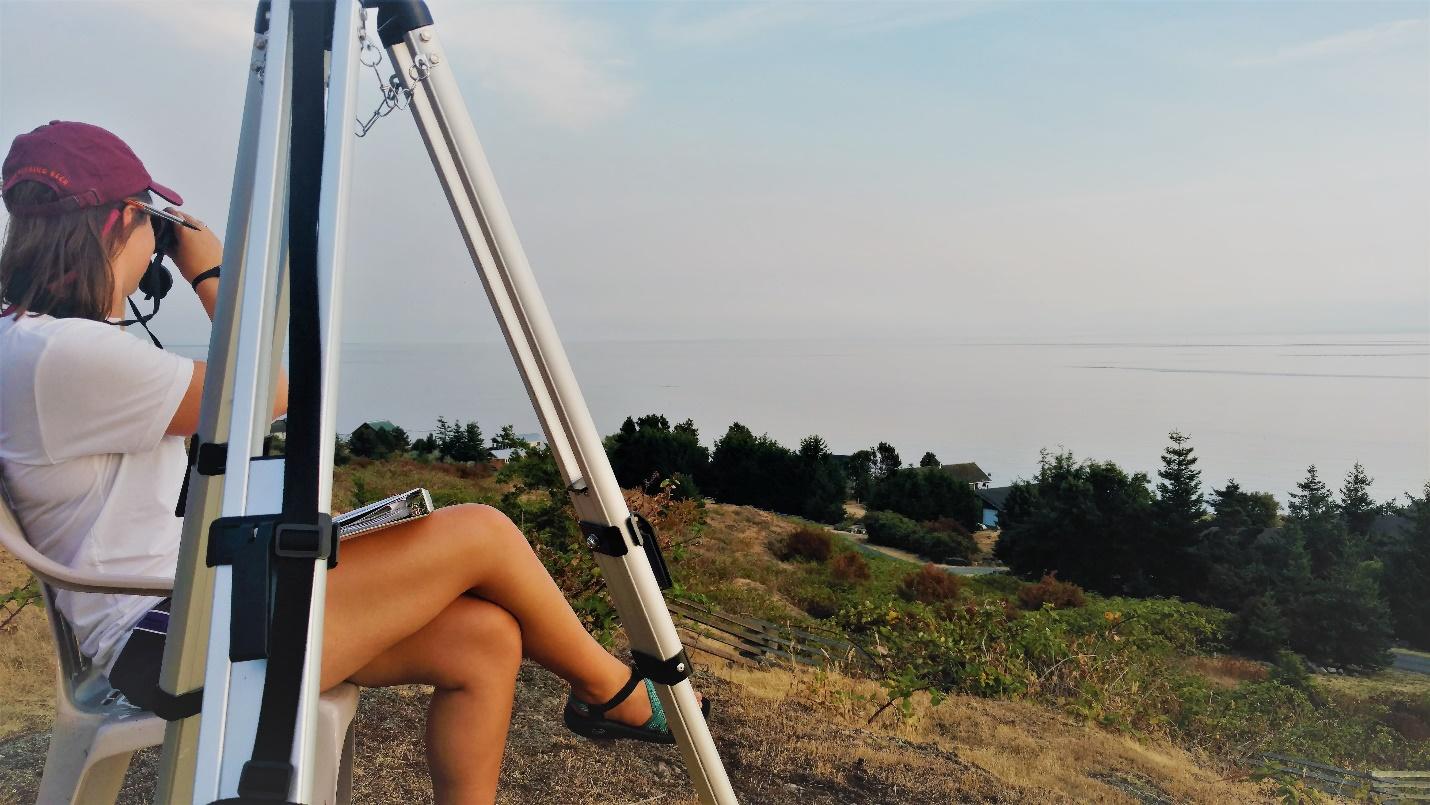
Scan sampling while also fixing theodolite data.
After this group of about 15 loosely dispersed whales passed out of view, we started to pack up our station until we suddenly heard another loud blow, much closer than the group we had been following. About a kilometer behind our initial group, came another steady train of foraging orcas. We learned later that night that there were members from all three southern resident pods in attendance–another superpod encounter! We continued our scan sampling and theodolite tracking for 40 more minutes until we could no longer hear their blows or pick out their fins against the smoky haze from the inland wildfires hovering above Haro Strait.
It has been a very rewarding few days and we are happy to report our second encounter with the southern residents after they have been on a month-long hiatus from the waters surrounding San Juan Island. Here’s hoping they find enough of that tasty chinook salmon and decide to stick around for a while.
–Laura
Comments
Archived from the original blog. New comments aren't accepted here.

Kaleigh
September 14, 2017I’m not one who knows a lot about killer whales, but I did have on question. How do the behavioral scans work? Is it a machine under the water? I’m just confused and starting to study the whales. Thank you for your time!

Scott Veirs
September 14, 2017Good question, Kaleigh! We’ll have a post with more detail soon I hope, but for now here’s a quick answer. The methodology is to observe the behavior visually when the killer whales are at the surface. We are doing this from land, but it is often done from a boat. On land, we have the advantage of a stable place (e.g. a tripod) on which we can put a theodolite (surveying instrument), a spotting telescope, and/or cameras. Any of these can be used to observe and record the behavior of an individual or a group. The trick is deciding how you are going to define different behaviors (with an ethogram). A scan usually involves monitoring a group of individuals. A “focal follow” instead focuses the observer’s attention on an individual that you try to follow between the locations where they surface sequentially (which can also be tricky and takes practice).